


GENEVA, Switzerland – A new research released in honour of World Water Week 2025 emphasises ongoing disparities that leave vulnerable communities behind.
Despite advancements in the past ten years, billions of people worldwide still do not have access to basic services like water, sanitation, and hygiene, which puts them at risk for illness and further social marginalisation.
During World Water Week 2025, WHO and UNICEF released a new report titled Progress on Household Drinking Water and Sanitation 2000–2024: special attention on inequities.
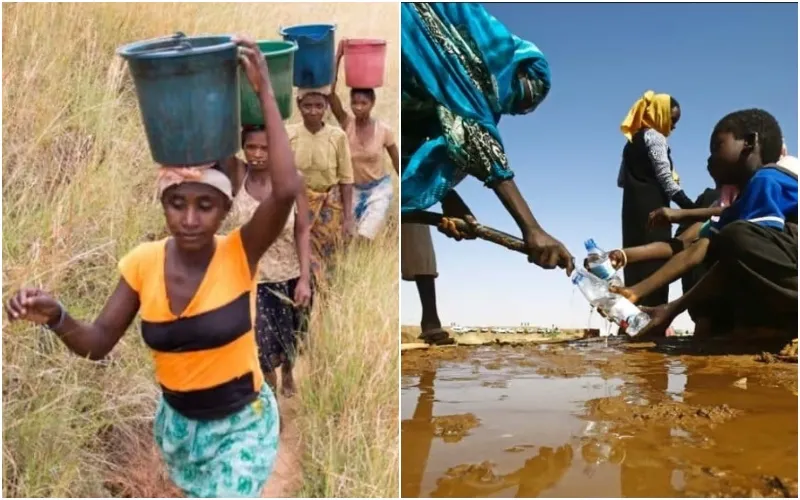
It shows that although there has been some progress, there are still significant gaps. The largest discrepancies are experienced by youngsters, members of minority ethnic and indigenous groups, those living in rural communities, those in low-income countries, and those living in unstable situations.
Ten key facts from the report:
– Despite gains since 2015, 1 in 4 – or 2.1 billion people globally – still lack access to safely managed drinking water*, including 106 million who drink directly from untreated surface sources.
– 3.4 billion people still lack safely managed sanitation, including 354 million who practice open defecation.
– 1.7 billion people still lack basic hygiene services at home, including 611 million without access to any facilities.
– People in least developed countries are more than twice as likely as people in other countries to lack basic drinking water and sanitation services, and more than three times as likely to lack basic hygiene.
– In fragile contexts**, safely managed drinking water coverage is 38% points lower than in other countries, highlighting stark inequalities.
– While there have been improvements for people living in rural areas, they still lag behind. Safely managed drinking water coverage rose from 50% to 60% between 2015 and 2024, and basic hygiene coverage from 52% to 71%. In contrast, drinking water and hygiene coverage in urban areas has stagnated.
– Data from 70 countries show that while most women and adolescent girls have menstrual materials and a private place to change, many lack sufficient materials to change as often as needed.
– Adolescent girls aged 15–19 are less likely than adult women to participate in activities during menstruation, such as school, work and social pastimes.
– In most countries with available data, women and girls are primarily responsible for water collection, with many in sub-Saharan Africa and Central and Southern Asia spending more than 30 minutes per day collecting water.
– As we approach the last five years of the Sustainable Development Goals period, achieving the 2030 targets for ending open defecation and universal access to basic water, sanitation and hygiene services will require acceleration, while universal coverage of safely managed services appears increasingly out of reach.
“Water, sanitation and hygiene are not privileges, they are basic human rights,” said Dr. Ruediger Krech, Director a.i, Environment, Climate Change and Health, World Health Organization. “We must accelerate action, especially for the most marginalized communities, if we are to keep our promise to reach the Sustainable Development Goals.”
“When children lack access to safe water, sanitation, and hygiene, their health, education, and futures are put at risk,” said Cecilia Scharp, UNICEF Director of WASH.
Dr. Ruediger further said: “These inequalities are especially stark for girls, who often bear the burden of water collection and face additional barriers during menstruation. At the current pace, the promise of safe water and sanitation for every child is slipping further from reach – reminding us that we must act faster and more boldly to reach those who need it most.”







Discussion about this post