


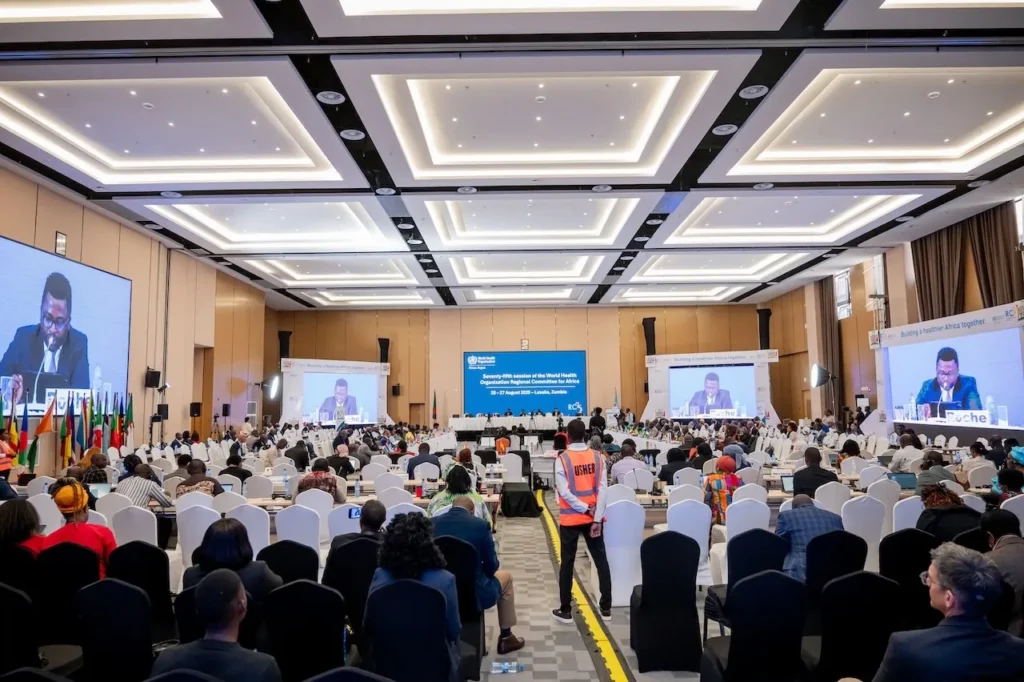
The 75th Session of the World Health Organization’s Regional Committee for Africa (RC75) concluded in Lusaka with African leaders and partners making strong calls to strengthen accountability for women’s, children’s and adolescents’ health (WCAH).
The session drew 43 statements ; 30 from Member States and 13 from partners making it one of the most dynamic moments of the gathering and highlighting the urgency of investing in the health and survival of Africa’s most vulnerable populations.
Every day, roughly 800 women and newborns die globally from preventable causes linked to pregnancy and childbirth. Africa shoulders the heaviest burden, accounting for 70 percent of maternal deaths and more than half of child deaths worldwide. While the continent has made progress, maternal mortality dropped by 40 percent between 2000 and 2023, neonatal deaths declined by a third and under-five mortality more than halved the pace remains too slow and uneven to meet the Sustainable Development Goals (SDGs) by 2030.
Delegates acknowledged both national progress and lingering challenges in the health sector. Health workforce shortages, weak data systems and gaps in essential commodities being the repeatedly raised issues in the meeting.
Kenya’s representative noted that “key challenges include commodity gaps and skilled health workforce attrition,” while Seychelles emphasized the need to “strengthen robust data systems to guide evidence-based decision making.”
Zambia, where the Partnership for Maternal, Newborn and Child Health (PMNCH) supports a collaborative advocacy plan, shared how they are using data to shape programmes and address health inequalities.
Sexual and reproductive health and rights (SRHR) also emerged as a priority. Malawi’s representative admitted that teenage pregnancy remains a pressing issue, saying they are investing in training for health workers and improving access to life-saving commodities.
At the same time, calls for greater investment in health were loud and clear. Seychelles called particularly for investment in health as a driver of socio-economic development.
Several other countries urged stronger domestic resource mobilization to sustain gains and reduce dependency on external funding.
However, despite decades of global and regional commitments to WCAH, leaders admitted that political will and financial commitments have often fallen short. Senegal, a member of the Global Leaders Network (GLN), called on the African Union to institutionalize accountability mechanisms, saying, “accountability is key to ensuring progress is made.”
Kenya echoed this, urging stronger regional mechanisms for accountability and greater use of data.
Moreover, the urgency of action was captured powerfully in the opening address by Zambia’s President Hakainde Hichilema, who shared his personal story. “I was born in a health center with no water, no electricity. My grandmother was the birth attendant,” he recalled. “This reality remains the same for too many African women and children today.”
President Hichilema outlined Zambia’s reforms, including expanding health facilities closer to communities, recruiting specialists and linking health with education so that more than 2 million children could return to school. He also underscored Zambia’s commitment to ensuring essential health services reach even fragile areas.
Looking beyond his country, he called on African leaders to unite around four priorities: building resilient health systems, boosting local manufacturing, strengthening regional solidarity and aligning national priorities with global health frameworks.
He also warned that recent global funding cuts threaten progress, noting that reduced U.S. funding could result in 14 million additional deaths by 2030, including 4.5 million among children under five
“These challenges are only beginning,” he said.
“We must see the opportunity in challenges. Dependency must be transformed into agency,”he further stressed.









Discussion about this post