


TURKANA, Kenya – For a long time, the agricultural sector in Turkana County has faced numerous challenges, including severe water scarcity, unreliable rainfall, poor soils, and limited infrastructure.
News Nine understands that these factors, coupled with high poverty levels and the devastating effects of climate change, largely contribute to food insecurity and hinder sustainable agricultural practices.
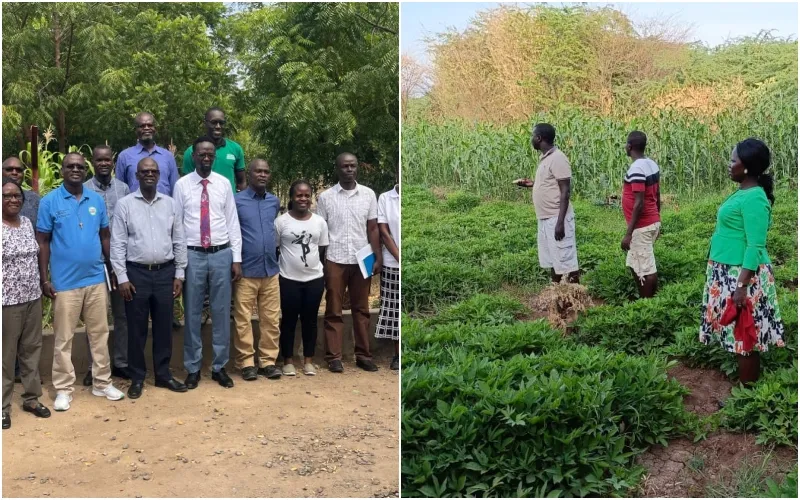
It is against this backdrop that farmers living in irrigation schemes in the sub-counties of Loima, Turkana West, Turkana South, and Turkana East have been asked to provide their opinions on the Turkana County Agriculture Policy, 2025, which the County Government has made public.
The goal of the strategy is to give a clear framework for directing county investments, coordinating public and private players, protecting equitable land and water usage, and encouraging innovations that increase food security and climate resilience for all Turkana citizens.
Participants were drawn from Tisa, Kolioro, Napol, Nanyee, Moruese, Natuntun, and Turkwell, as well as the irrigation projects in Loima Sub-County called Natirae.
What the county gov’t thinks about the Agriculture Policy 2025
A team from the Alliance of Bioversity-CIAT paid a courtesy call to Dr. Michael Eregae, the County Executive for Agriculture, Livestock Development, and Fisheries, earlier this week to inform him of the Centre’s support for policy matters and its intention to introduce climate-smart technologies suitable for the Turkana context.
He praised the research center’s assistance with the policy review and gave it the assurance that the government would see to it that the policy was eventually operationalised.
“While I extend my gratitude to the Alliance of Bioversity-CIAT for this initiative, I want to commend all the stakeholders who have worked on this proposed policy that will give a roadmap to improve the food security sector in Turkana, ensuring access to food, increased income, and improved livelihoods,” the CECM affirmed.
Dr. Eregae expressed his satisfaction that once the policy is ready, it will be operationalised in January 2026.
The Chief Officer for Agriculture and Land Reclamation, David Maraka, highlighted the need for the policy to focus on promoting the commercialisation of agriculture through the enhancement of suitable industrial crop varieties for agribusiness in Turkana.
How the Alliance of Bioversity-CIAT seeks to support the policy
Liz Ogutu, Team Lead for the project at the Alliance of Bioversity-CIAT, said:
“We are interested in making sure that climate-smart and climate-information technologies, practices, and innovations are well-represented in the Turkana Agricultural Policy,” she said, adding that the funding support is through the Accelerating Impacts of CGIAR Climate Research for Africa (AICCRA), in collaboration with the Turkana County government.
News Nine knows that this funding is aimed at reviving the policy development by supporting the public participation process and validation while focusing on the county-specific needs and aspirations.
Joseph Ekiru, a participant from the Tisa Scheme, said the policy should consider the aspect of compensation in the event their crops and irrigation infrastructure are washed away by floods from the Dam when it bursts its banks.
“There is also a need to have a farm title deed for legal and secure land ownership,” said Ekiru.
Why the County Agriculture Policy 2025 should address pastoralism
Joseph Lemuya from the Napak Irrigation scheme highlighted how food for work can be useful in promoting food security through irrigation rather than getting relief food for no apparent reason.
On her part, Mary Akiru, who represented the Tisa Irrigation Scheme, observed that there should be adequate availability of water for irrigated agriculture since water and food security are used simultaneously.
Vivian Achwa, a farmer from the Kolioro Scheme, emphasised that policy should focus on the integration of both the practice of pastoralism and agropastoralism in Turkana.
“I must add that there should be the establishment of medium-sized dams, water pans and earth dams to help farmers diversify their sources of livelihood,” stated Achwa.
What the County Agriculture Policy 2025 means to Turkana residents
Moving forward, Maraka said, “the next step after this policy is finalised is the development of a multi-sectoral implementation framework, bringing together stakeholders from government, civil society, and private and public sectors. This process will set out practical steps toward achieving the policy aims.”
News Nine has established that present were Richard Lokoyan (Director, Irrigation and Land Reclamation), Ekal Lokuruka (Director, litigation services), Emmanuel Esau (Deputy Director, Agriculture), and Dorcas Ejore (Deputy Director, Administration).
Others were Justus Eloto (Deputy Sub-County Administrator, Loima), Juma Vitalis, Okita Francis, Evans Keter, Peter Lochakwaan, Alphonse Abolem and David Eliokono (village Administrator).
Dorcas Jalang’o, Veronica Ndetu and Esther Nzuki (Alliance of Bioversity-CIAT) were also in attendance.










Discussion about this post