


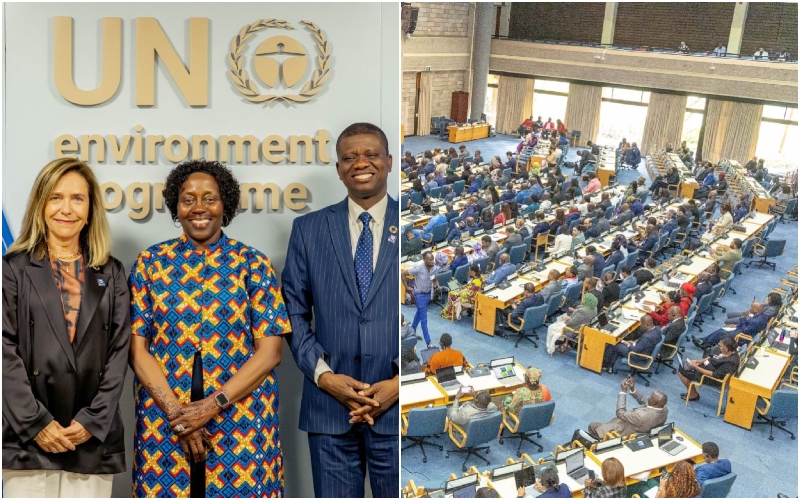
NAIROBI, Kenya – “Africa is not short of ambition or solutions… we must shift from shortfalls to delivery of finance,” said UN Climate Change director Cecilia Kinuthia-Njenga.
Speaking at the AMCEN Ministerial Dialogue, Kinuthia-Njenga reiterated the urgency of scaling up climate finance to support Africa’s adaptation and resilience efforts.
“Climate finance is not just a political choice – it is a matter of survival, of development, of dignity and equity,” the remarks underscored.
News 9 Kenya knows that Africa is on the frontlines of the climate crisis, losing up to 9% of its GDP annually to climate impacts, while trillions of dollars are needed to meet energy, adaptation, and resilience goals.
This challenge is compounded by a constrained fiscal environment where, in many countries, more is spent on debt servicing than on climate or health.
UNFCCC is working to strengthen institutional frameworks that can help African countries access sustainable climate finance.
What nations agreed in Baku, Azerbaijan
At last year’s COP29 Climate Change Conference in Baku, Azerbaijan, all nations reached an agreement on a new climate finance goal of USD 300 billion annually by 2030 to flow to developing countries, to be scaled up to USD 1.3 trillion by 2035.
“The $300 billion must be a floor, not a ceiling – and it must translate into predictable, accessible finance for those who need it most,” stressed the UN Climate Change representative. We are working to ensure that climate finance architecture responds to African priorities.”
According to Kinuthia-Njenga, UNFCCC is working to strengthen the enabling environment and institutional frameworks that can help African countries access and mobilise sustainable climate finance.
To achieve some of these milestones, Kinuthia-Njenga stated that Multilateral Development Banks must deliver more concessional finance, unlock private capital, and bring down the cost of borrowing through guarantees, risk-sharing instruments, and local currency lending.
She recounted that recent solar deals in Zambia show that structured, non-recourse project finance can deliver scale-off sovereign books while protecting debt sustainability.
How UNFCCC is achieving its goals in Africa
At UNFCCC, Kinuthia-Njenga indicated that they are working with Parties to strengthen national institutional capacity.
“Through the UNFCCC’s workstreams on capacity building, transparency, and climate finance readiness, we are helping countries develop the national enabling environments that turn finance into results,” she said.
News 9 Kenya knows that this includes support for planning, regulatory reform, and pipeline development. But still, Kinuthia-Njenga observed that more is needed.
“We must scale up demand-led technical assistance – especially for adaptation and just transition investments that deliver co-benefits across sectors,” she said.
Moreover, Kinuthia-Njenga reiterated that they are working to ensure that climate finance architecture responds to African priorities.
“The commitment to triple outflows from multilateral climate funds by 2030, and to double adaptation finance from 2019 levels, is a clear signal.”
How the Loss and Damage Fund should be implemented
But Kinuthia-Njenga insists that these goals must be backed by ambitious replenishments – for the Green Climate Fund, the Global Environment Facility, the Adaptation Fund, and the new Fund for Responding to Loss and Damage.
The Loss and Damage Fund, in particular, she said, must be fully capitalised and operationalised swiftly.
“Its success will be a test of whether our system can respond to devastating climate impacts in real time, with equity and solidarity at its core,” added the UN representative.
The African continent, according to Kinuthia-Njenga, is not short of ambition or solutions. But the gap between what is promised and what is delivered has been too wide for too long.
“We must shift from cycles of shortfalls to cycles of delivery. We have the instruments. We have the institutions. What we need is clarity, cooperation and political will – so that by the second global stocktake in 2028, we can report real progress: in resilience, in jobs, in energy access, and hope.” Kinuthia-Njenga concluded.





Discussion about this post